
Future-Proof Your Architecture: Top 7 Node.js & Go Microservices Best Practices for 2026
This comprehensive guide outlines the essential architectural and commercial strategies for building scalable, resilient, and cost-effective microservices using Node.js and Go, preparing your engineering teams for the demands of 2026 and beyond.
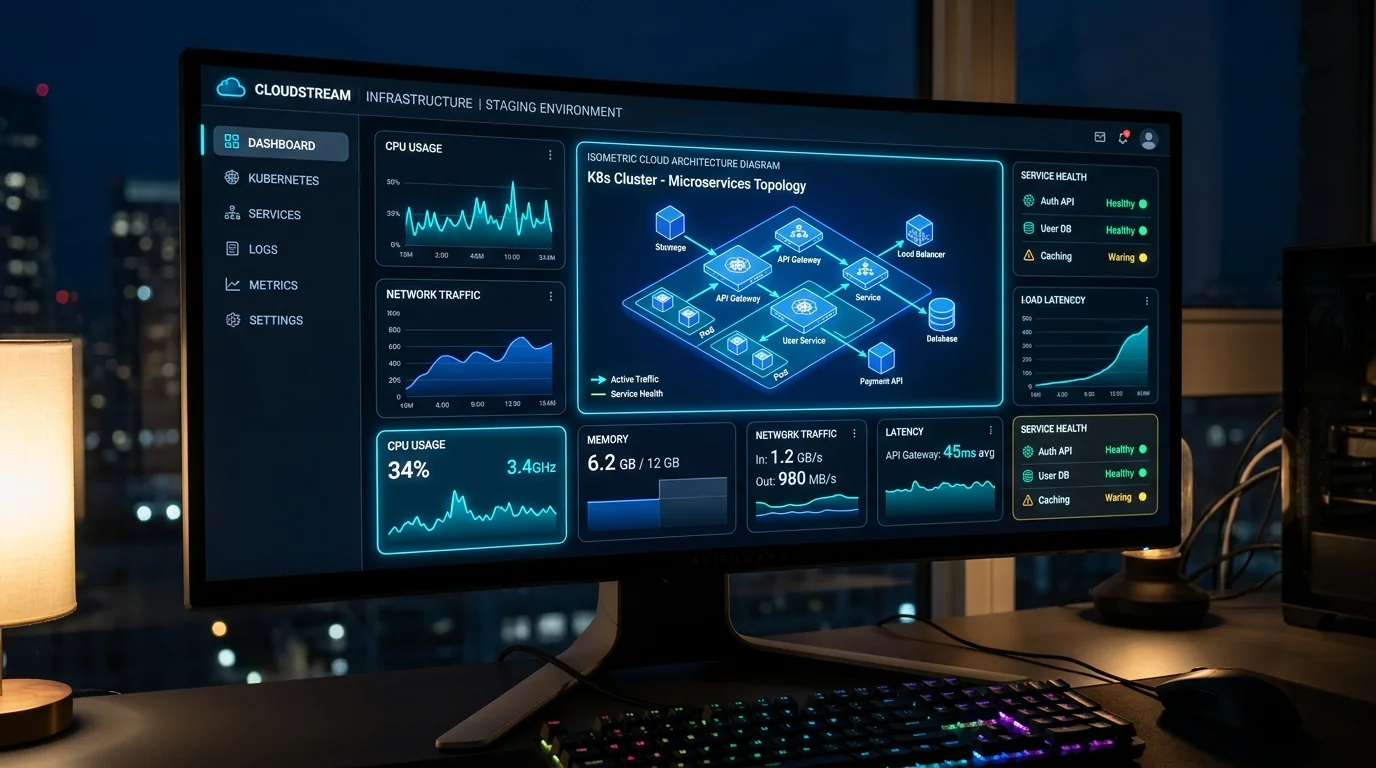
1. Executive Summary & Market Economics
By 2026, Node.js and Go will continue to solidify their dominance as the cornerstones of cloud-native microservices architectures. Their asynchronous, non-blocking I/O model (Node.js) and concurrent, high-performance capabilities (Go) make them indispensable for building scalable, resilient, and efficient distributed systems. CodeCurious Technologies anticipates a continued surge in adoption driven by the imperative for reduced time-to-market, enhanced operational resilience, and significant cost efficiencies.
The economic benefits of adopting modern microservices practices are profound. Organizations can expect lower operational overhead through optimized resource utilization, improved developer productivity via language-specific strengths and modular design, and a tangible reduction in infrastructure costs through intelligent scaling. Key trends for 2026 include widespread AI/ML integration for intelligent automation and data processing, further serverless adoption to abstract infrastructure, and an elevated focus on end-to-end observability to manage increasingly complex landscapes.
For organizations investing in India's robust software engineering talent pool, the economic landscape remains highly competitive yet value-driven. A skilled Senior Microservices Engineer specializing in Node.js or Go in India could command an annual salary ranging from ₹25 Lakhs to ₹45 Lakhs (approximately $30,000 - $55,000 USD) in 2026, depending on expertise and location. For a comprehensive microservices project involving design, development, and deployment over 6-9 months with a team of 4-6 senior engineers, the total project cost could range from ₹80 Lakhs to ₹1.8 Crores (approximately $96,000 - $215,000 USD). These investments yield substantial ROI through accelerated innovation and operational efficiencies.
2. Key Application Types & Capabilities
Understanding the inherent strengths of Node.js and Go is crucial for architecting optimal microservices. A hybrid approach often yields the most robust and performant systems.
Node.js Strengths:
- I/O-Bound & Real-time Applications: Ideal for applications requiring high concurrency with minimal CPU processing per request, such as chat applications, live streaming services, and collaborative tools.
- Event-Driven Systems: Its non-blocking nature excels in handling numerous concurrent connections efficiently, making it perfect for event sourcing and reactive architectures.
- High-Concurrency Web Servers: Excellent for building fast, scalable APIs and backend services that primarily interact with databases or external APIs.
Go Strengths:
- CPU-Bound & High-Performance Computing: Designed for raw speed and efficient resource utilization, making it suitable for data processing pipelines, complex calculations, and machine learning inference services.
- Robust APIs & Backend Services: Its strong typing, compilation to native code, and powerful concurrency primitives (goroutines, channels) make it ideal for building stable, high-throughput APIs and core backend services.
- Network Proxies & Infrastructure Tools: Go's performance and low-level networking capabilities are leveraged in building high-performance network services, load balancers, and command-line tools.
Hybrid Approach:
A strategic blend of Node.js and Go allows organizations to leverage each language for its optimal use case. For instance, Node.js might handle user-facing APIs and real-time communication, while Go powers critical backend services, data processing, or high-performance computation modules. This approach ensures high availability, fault tolerance, horizontal scalability, low-latency communication, and efficient resource utilization across the entire microservices landscape.
3. Feature-by-Feature Architecture & Cost Breakdown
Building a resilient microservices architecture requires a meticulous approach to core components. Here's a breakdown of essential features and their estimated implementation costs for a mid-sized enterprise:
Centralized traffic management, routing, authentication, and security policies are critical. A service mesh (e.g., Istio, Linkerd) extends these capabilities to inter-service communication, providing observability, traffic control, and mTLS. This module ensures secure, efficient, and observable communication across your services.
Implementing robust observability across distributed systems is non-negotiable. This includes distributed tracing (e.g., Jaeger, Zipkin via OpenTelemetry), centralized logging (e.g., ELK Stack, Loki), and comprehensive metrics (e.g., Prometheus, Grafana). Standardizing on OpenTelemetry ensures future-proof data collection.
Adopting polyglot persistence allows each service to choose the best database for its needs. Strategies like eventual consistency, data partitioning, and the Saga pattern are crucial for maintaining data integrity across disparate data stores. This module focuses on designing a scalable and consistent data layer.
Beyond the API Gateway, microservices security in 2026 demands mTLS for service-to-service communication, OAuth 2.0 for user authentication/authorization, and robust API key/secret management. Regular vulnerability scanning and adherence to security best practices are paramount to protect distributed assets.
Embracing GitOps principles, automated testing (unit, integration, end-to-end), and advanced deployment strategies like blue/green or canary deployments are essential. Infrastructure as Code (IaC) tools automate environment provisioning, reducing manual errors and accelerating deployment cycles.
Strategic choices between serverless functions and container orchestration (Kubernetes) significantly impact costs. Efficient resource allocation, auto-scaling policies, and adopting cloud-agnostic deployment strategies minimize vendor lock-in and optimize expenditure across cloud platforms.
Cost Matrix: Microservices Project (Mid-Scale, 6-9 Months)
| App Tier | Scope | Cost (INR / USD) | Timeline |
|---|---|---|---|
| Core Business Logic Services | Development of 5-7 critical Go microservices with robust APIs, data processing, and integration with message brokers. | ₹45 Lakhs - ₹75 Lakhs / $54K - $90K | 6-8 Months |
| User-Facing & Real-time Services | Development of 3-5 Node.js microservices for user authentication, real-time notifications, and API gateway integration. | ₹30 Lakhs - ₹50 Lakhs / $36K - $60K | 5-7 Months |
| Infrastructure & DevOps Setup | Kubernetes cluster setup, CI/CD pipelines, observability stack (logs, metrics, tracing), security configurations, and IaC implementation. | ₹25 Lakhs - ₹40 Lakhs / $30K - $48K | 4-6 Months |
| Data Layer & Integration | Design and implementation of polyglot persistence strategy, database setup (e.g., PostgreSQL, MongoDB), message broker integration (Kafka/NATS). | ₹35 Lakhs - ₹60 Lakhs / $42K - $72K | 5-7 Months |
| Total Estimated Project Cost | Comprehensive microservices architecture, including development, infrastructure, and deployment. | ₹1.35 Crores - ₹2.25 Crores / $162K - $270K | 6-9 Months (overlapping phases) |
4. Recommended Technology Stack in 2026
The following technology stack represents a robust and future-proof choice for Node.js and Go microservices in 2026, balancing performance, scalability, and maintainability:
- Languages/Runtimes:
- Node.js: Latest LTS versions (e.g., Node.js 22+), leveraging modern JavaScript features and performance enhancements.
- Go: Latest stable versions (e.g., Go 1.22+), benefiting from continuous improvements in concurrency and standard library.
- Frameworks:
- Containerization & Orchestration:
- Docker: For containerizing individual microservices.
- Kubernetes: Managed services like AWS EKS, Azure AKS, Google GKE for robust orchestration, scaling, and self-healing.
- Cloud Platforms:
- AWS, Azure, GCP: Leveraging native services (e.g., Lambda/Functions, SQS/Event Hubs, DynamoDB/Cosmos DB) for optimal scalability, cost-effectiveness, and managed operations.
- Databases:
- Relational: PostgreSQL (for strong consistency, complex queries).
- NoSQL: MongoDB (for flexible schema, document storage), Redis (for caching, session management), Cassandra (for high-volume, distributed data).
- NewSQL: CockroachDB (for globally distributed, highly available relational data).
- Message Brokers:
- Apache Kafka: For high-throughput, fault-tolerant event streaming.
- RabbitMQ: For reliable message queuing and complex routing.
- NATS: For high-performance, lightweight messaging and request-reply patterns.
- Observability Tools:
- Prometheus & Grafana: For metrics collection and visualization.
- Jaeger/Zipkin: For distributed tracing, integrated with OpenTelemetry.
- ELK Stack (Elasticsearch, Logstash, Kibana) / Loki: For centralized log aggregation and analysis.
- OpenTelemetry: For standardized, vendor-agnostic instrumentation.
- Service Mesh:
- Istio: For advanced traffic management, security, and observability at the network layer.
- Linkerd: For a simpler, lightweight alternative focusing on mTLS and traffic shaping.
- CI/CD Tools:
- GitHub Actions, GitLab CI/CD: For integrated source control and CI/CD.
- Argo CD, Tekton: For GitOps-driven continuous delivery and cloud-native pipelines.
5. Frequently Asked Questions (FAQ)
Q: When should I choose Node.js over Go for a specific microservice, and vice-versa?
A: Choose Node.js for I/O-bound services that require high concurrency with minimal CPU processing per request, such as real-time chat, streaming data, user-facing APIs, or event-driven systems. Its asynchronous nature excels in handling many concurrent connections efficiently. Opt for Go when your microservice is CPU-bound, requires high computational performance, or needs low-level system interactions. Examples include data processing pipelines, complex algorithmic services, high-throughput backend APIs, or network proxies. Go's strong typing and efficient concurrency make it ideal for robust, performance-critical components.
Q: How do I ensure data consistency across multiple microservices with different databases?
A: Ensuring data consistency in a polyglot persistence microservices architecture typically involves embracing eventual consistency. Strategies include the Saga pattern, where a sequence of local transactions is coordinated across services, with compensating transactions to handle failures. Event Sourcing, where all changes to application state are stored as a sequence of events, can also facilitate consistency and provide an audit trail. Additionally, implementing robust idempotency for API calls and using distributed transactions (e.g., two-phase commit) sparingly for critical, tightly coupled operations, while understanding their performance implications, can help. Monitoring and alert systems are crucial to detect and resolve inconsistencies quickly.
Q: What are the critical security considerations for Node.js and Go microservices in 2026?
A: In 2026, critical security considerations include implementing mTLS (mutual TLS) for all inter-service communication to ensure authenticity and encryption. Robust API Gateway security with OAuth 2.0 or OpenID Connect for external authentication and authorization is essential. Centralized secret management (e.g., HashiCorp Vault, AWS Secrets Manager) for API keys, database credentials, and certificates is non-negotiable. Regular, automated vulnerability scanning of dependencies and codebases, along with adherence to OWASP Top 10 for API security, are paramount. Furthermore, implementing strong rate limiting, input validation, and comprehensive audit logging for all services helps detect and mitigate threats.
Conclusion
Navigating the microservices landscape in 2026 with Node.js and Go requires a strategic blend of technological foresight and architectural rigor. By adopting these best practices – from intelligent language selection and robust architectural patterns to advanced observability and stringent security – organizations can build future-proof systems that are not only performant and scalable but also cost-efficient and resilient. CodeCurious Technologies is committed to empowering engineering teams to master these complexities, transforming challenges into opportunities for innovation and sustained growth.
"This comprehensive guide outlines the essential architectural and commercial strategies for building scalable, resilient, and cost-effective microservices using Node.js and Go, preparing your engineering teams for the demands of 2026 and beyond."

Have A Challenging System To Build?
Let's Engineer It Together.
Partner with our senior engineering squad to architect high-concurrency mobile apps, SaaS platforms, and enterprise AI systems.